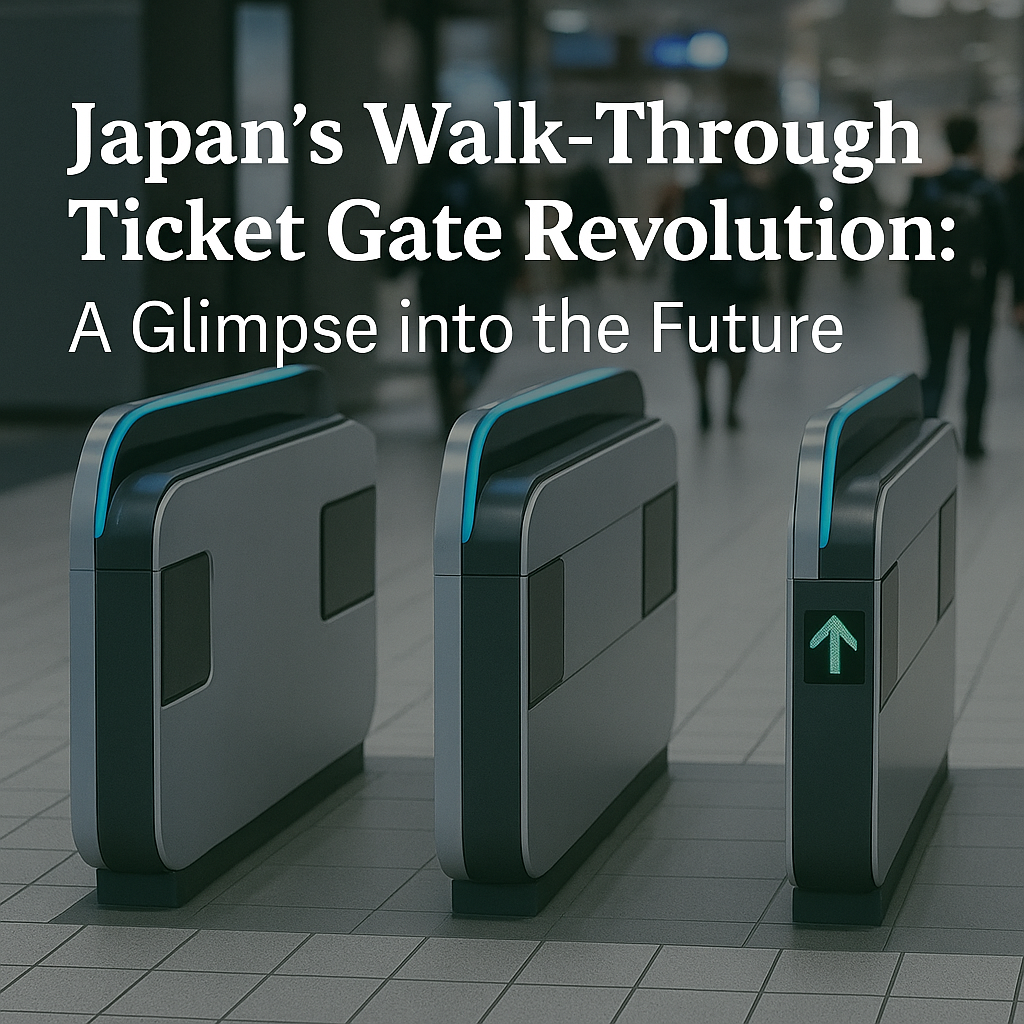
Japan’s railway system—a model of efficiency—continues to evolve, and the latest innovation on the horizon is the walk-through, touchless ticket gate. These new gates are poised to redefine how commuters and visitors breeze through stations, blending convenience with cutting-edge tech.
JR East’s “No-Touch” Gates with Suica Evolution
In December 2024, JR East unveiled plans to phase in walk-through gates across its network within the next 10 years, allowing passengers to skip tapping their Suica cards entirely.
The system works by collecting mobile Suica location data centrally, enabling automatic authentication as you walk through—no stops, no fuss.
A sleek update to the Mobile Suica app is expected by fall 2026, enabling post-pay features by linking directly to bank accounts or credit cards.
Starting autumn 2025, facial recognition-based walk-through gates will be tested at Niigata and Nagaoka stations on the Jōetsu Shinkansen, focusing on passengers with Suica-based commuter passes.
By spring 2027, trials of non-facial technologies for local lines are set to begin, all targeting full implementation within a decade.
Osaka Metro’s Leading Edge: AI Facial Recognition
Osaka Metro launched its full-scale facial-recognition walk-through gates in March 2025.
Powered by Panasonic Connect and Takamisawa Cybernetics, these gates recognize faces through deep-learning-powered cameras—no ticket, no IC card needed.
Privacy measures are strong: images are deleted immediately post-authentication, cameras monitor only the gate area within 30 cm, and users must opt-in.
Initially supporting special passes like the 26‑ or 48‑hour “e METRO” ticket, plans exist to expand to regular commuter or prepaid tickets—and even other transport partners.
Advantages & Broader Benefits
Hands-free convenience: Ideal for travelers with luggages, cyclists, parents with strollers, or commuters with phones buried in pockets.
Accessibility improvement: Easier for wheelchair users and left-handed passengers, removing the asymmetry of side-mounted sensors.
Operational efficiency: Faster flow during rush hours; gates refresh every 10+ years, so new infrastructure is timely.
Digital ecosystem expansion: JR East’s Suica is evolving into a full-fledged digital lifestyle platform—covering travel, payments, vouchers, even public services.
What This Means for Travelers
For locals, preparing for a future where tapping a card becomes old-fashioned.
For tourists, starting 2025 in Osaka or later in JR East regions, you may pass through gates without a card—if registered.
For tech enthusiasts, Japan is a testbed for biometric and mobile-integrated public transport across Asia.
Looking Ahead
Japan is setting the stage for a transport experience that’s not only faster and smoother but also completely hands-free and integrated into daily life. By integrating biometric recognition, mobile data, and digital infrastructure, Japan’s walk-through gates are less about novelty and more about a smart, inclusive future in public transit.
Keep an eye on Osaka Metro in 2025 and JR East from 2027 onward—these walk-through strides are turning into tracks of tomorrow’s commute.


コメント